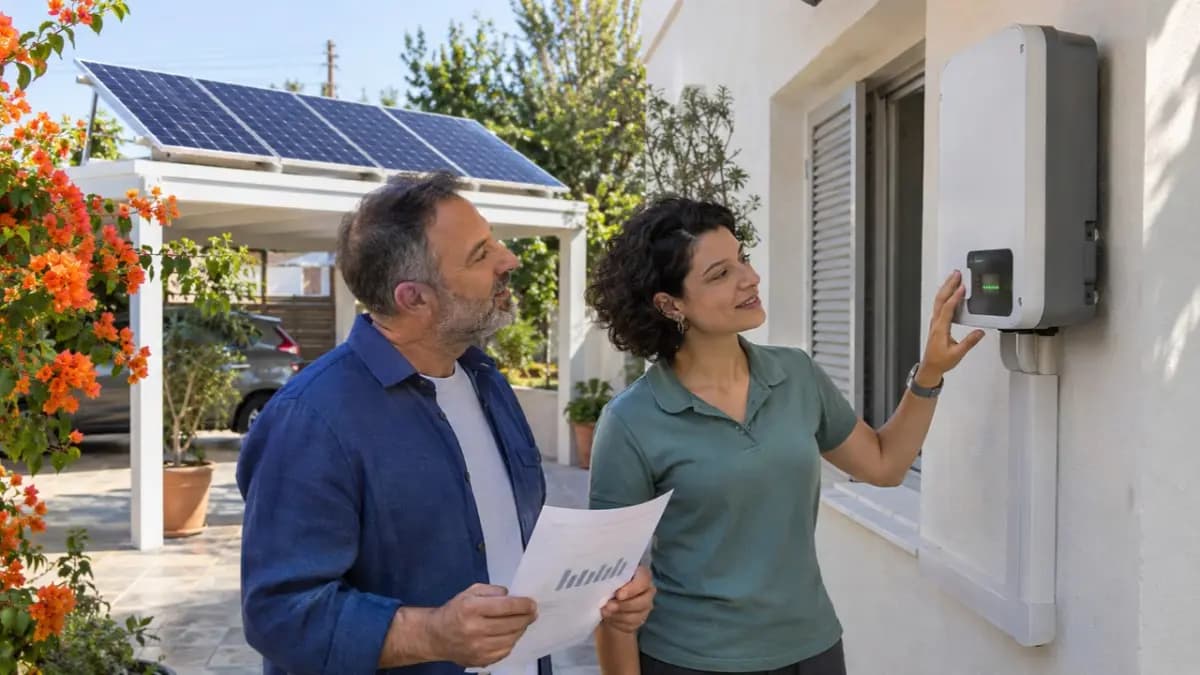
Two homes each use 7,500 kilowatt-hours (kWh) of electricity a year. In one, the air conditioning cools the living room during the day while the owners work from home. In the other, it comes on when the family returns in the evening. Even with identical panels on identical roofs, their bills can differ considerably. The first home uses more solar electricity as it is generated. The second exports its daytime surplus and buys electricity in the evening. The cost of that exchange depends on the supply contract.
If you are choosing panels for a home in the Republic of Cyprus, start with three figures: how much electricity your roof can generate during the day, how much your home can use at the same time, and how your supplier will account for the surplus. Together, these let you estimate savings in euros and decide whether a battery is worth the extra cost.
How much solar electricity can your home use straight away?
Gather your electricity bills for the past 12 months. If you have yet to install panels, record how many kWh your home bought from the grid. If you are buying a home with an existing system, ask the seller for separate import and export readings and a monitoring report covering the same dates. You need both the panels’ output and the home’s total consumption. Since some electricity comes directly from the roof, grid purchases can be substantially lower than total use. If the report has gaps, ask the installer to reconstruct the missing data and identify any estimates.
If your meter provides hourly or half-hourly readings, send the installer that data. Otherwise, at least note when major appliances run on a typical weekday and weekend day in summer and winter. The installer can then show several scenarios and explain the range of results.
Look for two distinct figures in a solar quotation. The panels’ peak power is their rated output under standard test conditions, expressed in kilowatt-peak (kWp). To estimate the effect on your bill, you need electricity generation in kWh and its distribution over time. For an initial forecast, locate your home on a map and specify the panels’ tilt and orientation. Ask the installer to account separately for shade from neighbouring buildings, parapets and rooftop water tanks. Compare the forecast with consumption during the same hours. If the home is empty in August, its strong August generation potential mainly matters when estimating the surplus. European Commission guide to estimating solar generation
Can you use the roof and export surplus electricity?
For a detached house, gather the building plans and documents. For an apartment, add the title document, registered plan and rules governing shared property. Even if the only access to the roof is through your apartment, your lawyer will need to establish who owns the proposed installation area, who can approve the fixings and where the cable will run to your meter. It is best to clarify these points before commissioning the design. Republic of Cyprus immovable property law, Part IIA
Some legally existing buildings qualify for solar installation without separate planning permission. Eligibility depends on the building’s status, its zone and the position of the panels on the roof. Show an engineer the proposed layout and ask them to check whether the project meets the conditions and which building approvals are required separately. The engineer should also assess roof loading, fixings, waterproofing and maintenance access. If the roof will soon need repairs, include panel removal and reinstallation in the budget. Conditions for rooftop panel installations, category XIII A.1
Next, obtain the technical conditions from the Distribution System Operator (DSO). Ask about the permitted capacity at your address and whether export restrictions apply continuously or only at certain times. Temporary Zero Export requires a written application and the operator’s approval. While the panels are generating, the home can use their electricity directly and charge a battery. Only the surplus that neither the home nor the battery can absorb is lost. In exceptional circumstances, the operator can stop generation altogether. During those hours, the panels also stop supplying the home. Ask the installer to show forecast losses in kWh separately for each applicable restriction. Operator’s connection guide, sections 4.1 and 4.6 · Operator’s notice on temporary export restrictions
How your contract turns kilowatt-hours into euros
When buying a home with panels, ask the seller for the contract, the connection application date and recent bills. Check with the supplier which terms will remain in place after ownership changes. The Electricity Authority of Cyprus (EAC) states that a contract under the previous net metering scheme is available only to customers who applied to the operator by 31 December 2025 inclusive. For a new installation, request the terms the supplier currently offers. Schemes and the transition deadline
If the offer uses net billing, ask the supplier to walk you through a sample bill: the period over which readings are compared, the amount of electricity valued in euros, whether a credit can be carried forward or paid out, and which charges remain. Suppose a home imports and exports 1,000 kWh in one billing period. If each imported kWh costs €0.30 and the supplier pays €0.08 for each exported kWh, the difference is €220. If those kWh are fully offset within the period, the net energy balance is zero, although network and fixed charges may still apply under the contract. Use the formula in the contract offered to you.
What should the installation price include?
To compare two quotations for a 5 kWp system, send both installers the same list. For every item, ask whether it is included in the total, who is responsible for the work and what any excluded service costs.
- Equipment. Request the models, number of panels, their combined peak power and the output capacity of the inverter, which converts electricity for use in the home. Compare generation forecasts for the same roof.
- Roof and electrical work. Itemise fixings, lifting equipment, electrical protection, cabling to the distribution board, board alterations and restoring waterproofing. A long cable route from a shared roof to an apartment can change the total even with the same panels.
- Connection and handover. Check the cost of design, applications, inspections, meter work and setting up monitoring. Request the final price including Value Added Tax (VAT), plus a list of charges the owner pays directly.
- Battery and backup power. Get two totals: with and without storage. For the battery, request its usable capacity in kWh, available power in kW and a list of appliances it can supply during a grid outage. Include backup operation and its handover test as separate items in the quotation.
- After installation. Ask who monitors faults, what a call-out costs, who pays for labour during a warranty replacement and when an inspection will be needed. Separate annual costs from the initial price.
Suppose one installer quotes €7,000 for a system including installation and another quotes €7,200 for the same equipment. The first charges an extra €350 to lift the panels onto the roof; the second includes lifting. With taxes and all other work accounted for on the same basis, the first installation costs €7,350 and the second €7,200. The second offer is €150 cheaper.
Start by comparing the full prices you would pay yourself. If a quotation already deducts a subsidy, also request the price before that deduction. Applications for category A1, “Photovoltaics – General Category”, under the 2024–2025 programme closed on 31 May 2026. To include support in your calculation, you need a specific programme, approval for your property and the amount of eligible expenditure. Subsidy application conditions
One system, two patterns of electricity use
Suppose a 5 kWp system costs €7,000 for each of two homes and generates 7,500 kWh a year after restrictions. Each home also uses 7,500 kWh annually. Every kWh used immediately reduces the variable part of the bill by €0.30. Every kWh exported earns a separate €0.08. Allow €100 a year for maintenance. All figures are illustrative. When substituting your own data, include only the bill items that fall as electricity purchases decrease. The standing charge remains after installation.
Evening use. Of its 7,500 kWh annual consumption, the home meets 2,250 kWh directly from the roof and buys the remaining 5,250 kWh from the grid. It also exports 5,250 kWh of daytime surplus over the year. The owners save €675 on purchases and receive €420 for exports. After maintenance, the annual benefit is €995. With conditions unchanged, the simple payback period is €7,000 / €995, or 7.0 years.
Daytime use. The home uses 4,500 kWh directly and exports 3,000 kWh. Reduced purchases save €1,350, while exports earn €240. After maintenance, the annual benefit is €1,490. The same installation pays for itself in about 4.7 years. The €495 annual difference comes from 2,250 kWh that replace daytime purchases at €0.30 each instead of being sold for €0.08.
How much does the contract affect the result? If export payments fall to zero while generation, direct use and all other conditions stay the same, the evening-use home retains €575 a year and the daytime-use home €1,250. Across these two export prices, payback ranges from 7.0 to 12.2 years for the evening-use home and 4.7 to 5.6 years for the daytime-use home. Borrowing costs, declining output as equipment ages and equipment replacement sit outside this calculation. If you are borrowing to buy the system, compare the savings with your repayment schedule and add planned replacements to the costs for the years in which they are expected.
Will a battery pay for itself separately?
Return to the evening-use home and an export price of €0.08. Suppose a battery adds €4,000 to the purchase price. Over a year, it takes in 2,000 kWh of daytime surplus and, after losses, supplies 1,800 kWh to the home in the evening. This is the annual volume of energy passing through the battery. To estimate it for a particular unit, the installer needs its usable capacity and hourly charging and consumption profiles.
The home buys €540 less electricity but gives up €160 in payments for electricity previously exported. Additional maintenance costs €50. The battery therefore adds €330 in annual savings. Together, the panels and battery cost €11,000 and provide €1,325 in annual savings. The complete system pays back in about 8.3 years, while the extra investment in the battery takes 12.1 years. Compare that second period with the warranty, expected replacement date and how long you plan to live in the home.
If your main reason for buying a battery is to keep the fridge and lights running during outages, request a separate estimate of backup hours at your chosen load. That function has its own value, even when shifting solar electricity into the evening brings modest savings.
What to request before paying a deposit
Send the installer your annual bills, consumption profile and roof plan. Request two calculations for your address: one without a battery and one with it. Each should show the full price, electricity used at home, electricity exported, generation lost to restrictions and annual costs. Ask the supplier to demonstrate how your bill would be calculated. Then compare two scenarios for each billing period, using identical household consumption and contract terms. What would you pay without panels? What would you pay with them, including grid purchases and credits for surplus electricity?
To find the annual saving, add up the differences across all billing periods in the year. Add export payments if they are accounted for separately from the bills, then deduct maintenance costs. Count carried-forward credit as it reduces a bill. If your supplier offsets kWh within a billing period, repeat the comparison between daytime and evening use under those rules.