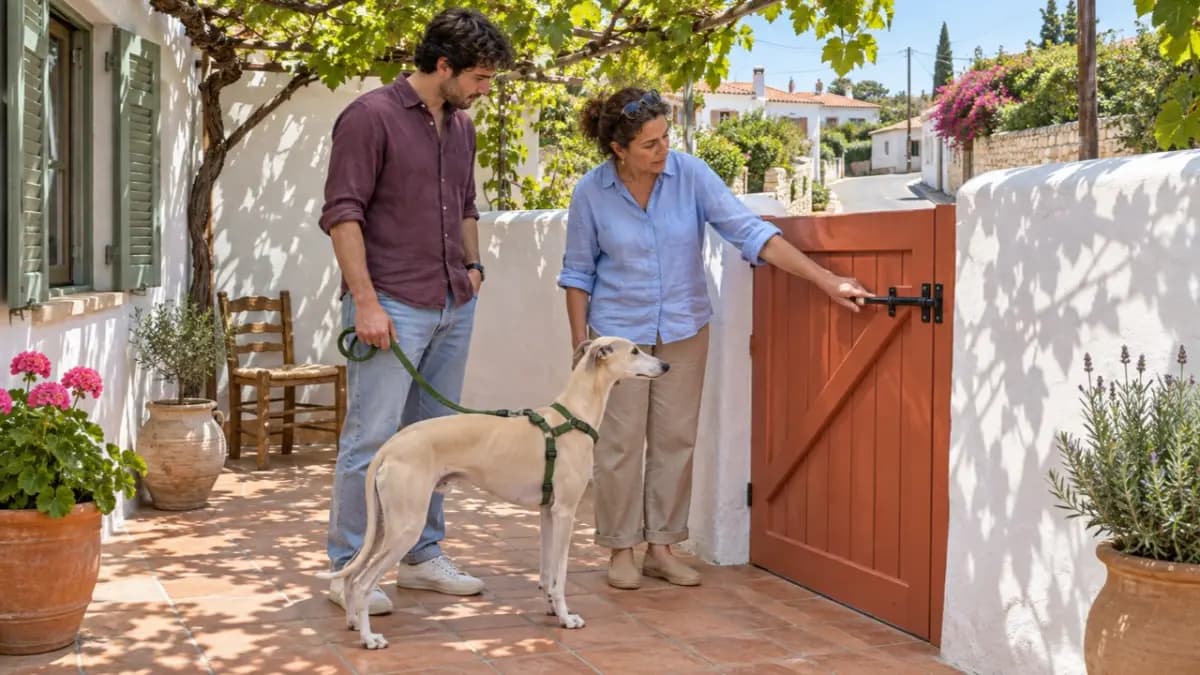
If you are looking for a long-term rental, tell the owner about your pets before arranging a viewing. Before making the first payment, check that their reply matches the tenancy agreement and the building rules. If you have two cats, the agreed wording should cover both of them. A pet-friendly label can help you find a listing; the next step is to establish the conditions for your particular pets.
This article covers ordinary household pets in the government-controlled areas of the Republic of Cyprus.
1. Describe your pets and contact the owner
State the species and number of animals. For a dog, include its approximate weight, especially if the owner is willing to accept only a small dog. Add a practical detail that affects your choice of home. An older dog, for example, may struggle with stairs. Ask whether there are any steps between the street entrance and the lift. If you walk your dog late in the evening, check whether the exit through the shared courtyard is open at that time.
Start by selecting long-term rentals. RentSpot's Russian-language collection has a “Питомцы разрешены” (“Pets allowed”) filter to narrow the search. If holiday accommodation appears in the results, check the rental period in the description: an owner may welcome a dog for a week, while you need a home for a year. Search for pet-friendly rentals in Cyprus
Two listings in the Limassol area, checked on 2 November 2026, show how to frame your first question to the owner.
- Germasogeia. The apartment listing allows one small dog. If you have two, give the weight of each and ask whether the owner would accept both. Until you receive a reply, treat the offer as covering one dog. Terms in the Germasogeia apartment listing
- Limassol's historic centre. The owner is willing to accept a small pet subject to an additional pet deposit. The listing does not specify the amount. Ask how much it is, whether there is a separate deposit for the apartment, which costs may be deducted and when the balance will be returned. Terms in the central Limassol apartment listing
Message to the owner or agent before a viewing
Hello, I’m interested in renting [address or listing ID] from [date] for [term]. I’d be moving in with [number, species and size of pets]. Would the owner agree to include these pets in the tenancy agreement for the full term? Could you send me the draft agreement and the current building rules? I’d like to check the conditions for keeping them in the apartment and using the shared areas with them. If there is an extra payment for pets, how much is it and what does it cover? Is it refundable? If so, when would it be returned and what deductions could apply? We would also need to agree on [for example, fitting a protective net to the balcony].
If the owner is concerned about the furniture and you have previously rented a furnished home with the same pet, offer a reference from your previous landlord. Ask them to describe briefly the condition of the sofa and flooring when you moved out. Get their permission before sharing their contact details for a call.
2. Check the building rules
If the apartment is in a jointly owned building, clarify two separate matters. The owner agrees who may live in the apartment. The rules applying to that address set out how the building and shared areas may be used. Ask the owner for the current text and the clause on animals. If you are renting a house with shared gates or a garden, first establish whether it belongs to such a development. Registering building regulations
Under section 38ΚΑ of Chapter 224, standard regulations apply where a building has no registered regulations. Where registered regulations leave a particular matter unaddressed, the relevant standard provision applies. Application of the standard regulations
The opening wording of regulation 8 refers to prior consent from the management committee. Subparagraph 8(ια) includes a qualification for a household pet that causes no disturbance and is kept in accordance with the laws and regulations in force. Read the two parts together. If an agent says the committee has banned pets, ask for the dated decision and check its scope: keeping a pet in the apartment, passing through the entrance hall or using the garden. If the documents conflict, show them to a Cyprus lawyer before paying. Regulation 8 and the provision on household pets
3. Inspect the apartment and the route to your walking spot
Walk the route you will use every day. For a dog, start at the apartment door and continue to the place where you plan to walk it. Look for steps and any points where you would need to step into the road. Check that the gate closes. If your dog barks at the lift or the front door slamming, listen for how clearly those sounds carry into the apartment.
For a cat, check how the windows and balcony door close. Look for gaps in the balcony railing that the cat could get through. If you plan to use the balcony only once a protective net is installed, show the owner where it would be attached. Before signing, agree on the fixing method, who will pay for installation and whether you must remove it when you leave. If drilling into the façade is prohibited, decide whether you could live there with the balcony kept closed.
If the apartment would only work for you with a net, ask the owner to include permission to install it in the draft agreement.
4. Put the agreed terms in the tenancy agreement
Suppose a listing says “pet-friendly”. You tell the agent that you have two cats, and the reply is “the owner agrees”. If the draft agreement still contains a ban on pets, send that clause to the agent and ask the owner to agree on replacement wording. One option to discuss is: “The owner agrees that the tenant may keep two domestic cats in the apartment at [address] for the full tenancy term. The parties will agree in writing before any additional pet is brought into the home.” Check the final agreement and its attachments. If a representative is signing, ask for evidence of their authority.
Record separately who pays for cleaning and how you will agree repair costs if a pet damages something. For example, decide who will arrange sofa cleaning, when it would be required and how the cost will be documented. If the owner asks for a pet deposit, state the amount, the grounds for deductions and the deadline for returning the balance. If they require a fixed, non-refundable cleaning fee, list it separately. Before transferring money, you will then be able to see how much is refundable if there are no grounds for deductions.
The length of the tenancy affects the signing requirements. For a property lease longer than one year, section 77(1) of Chapter 149 requires a written agreement. Each person accepting obligations under it must sign at the end of the document in the presence of at least two witnesses who have the legal capacity to enter into contracts. The witnesses must also sign. A representative may sign for a party if they have that capacity and are authorised to sign on the party's behalf. For a tenancy of exactly one year, a written pet clause still gives both sides an agreed text to refer to. Formal requirements for longer leases, section 77
The provisions on building regulations and the formal requirements for tenancy agreements were checked on 2 November 2026.
Check three things before the first payment
- The final agreement gives the correct address and tenancy term and covers all your pets. Its attachments are consistent with that permission. For every separate payment, you understand the amount, purpose, grounds for deductions and refund terms.
- You have received the building rules and established the conditions for living there with your pets and using the access routes and shared areas you need.
- You have inspected the apartment. If alterations are needed, you and the owner have agreed in writing who will pay and what must be restored when you leave.
If the owner agrees verbally but keeps a pet ban in the agreement, postpone payment. If they will accept only one of your two cats, keep looking.
5. Record the condition at move-in and move-out
When you collect the keys, inspect the flooring, doors, screens and upholstery with the owner. Record the precise location of existing marks or damage in the inventory and attach dated photographs. Sign two copies, keeping one each. Make sure both of you can open the photos.
If you find two snags on the sofa at move-in, note their exact location. You could write: “Two snags on the left armrest of the grey sofa.” Take a photograph of the whole sofa, followed by a close-up of the affected fabric. Repeat both shots when you move out. If the owner proposes deducting the cost of upholstery repairs, compare the photos and ask them to identify the new damage in the inspection record. If a third snag has appeared, discuss the repair method and cost separately. If only the original two are visible, attach the move-in record to your request for a revised deduction. Keep the reply, the calculation and the agreed refund deadline.