Start with 12 months of bills and charges for the property. Add internet, local charges, maintenance and insurance, then set aside separate amounts for a reserve and the cost of setting up services. The annual total depends on the equipment, household size, seasons and services covered by the development, as well as the size of the home.
This guide covers homes in the government-controlled areas of the Republic of Cyprus. The apartment and villa budgets use illustrative figures; published supplier rates appear separately with sources. The water tariff example applies only to the service area of the Limassol District Local Government Organisation, EOA Lemesos. Before signing service contracts, check the current rates and terms for the address.
Build a profile of the property
Record the address, floor area, number of residents and months of occupation. List air conditioners, heating, water-heating equipment, pumps, the garden and any swimming pool. If the home has a photovoltaic system, ask for its contract and billing history: the electricity it generates affects the bill according to the arrangements for that property.
Check how the water is heated. Solar water heaters and photovoltaic systems serve different purposes. Establish whether electric water heating is needed in winter and how often the pool pump runs. If bottled gas is used for cooking or heating, multiply the cost of a refill by the expected number of purchases over the year.
For an apartment, ask the building manager for the annual budget and a breakdown of charges, including outstanding balances and approved work. For a house outside a shared development, include upkeep of its equipment, garden and pool. Tenants should use the tenancy agreement to separate their payments from the owner's costs.
What to include in the budget
Electricity: look at the full bill
Check the meter number, tariff category, consumption in kilowatt-hours and every charge for each billing period. A bill may include consumption charges, fixed charges, a fuel adjustment charge, and applicable levies and taxes. Ask the supplier for the current tariff and bills covering the periods you need. Together, these show the full cost of supply. For a home with solar generation, also review the terms of its contract.
Water and sewerage
The water supplier depends on the address. For example, the published standard domestic tariff for the water supply area served by EOA Lemesos covers a four-month period. It includes a fixed charge of €16 and a €6 maintenance charge, followed by €0.90 per m³ for the first 40 m³ and €1.43 per m³ for the next 40 m³. The next 40 m³ cost €2.45 per m³, and consumption above 120 m³ costs €5 per m³. A separate scale applies to large families; check eligibility with EOA Lemesos. The page lists value added tax (VAT) at 5%. Water supply tariffs.
At an illustrative consumption of 60 m³ over a full four-month period, the water calculation is (€16 + €6 + 40 × €0.90 + 20 × €1.43) × 1.05 = €90.93, or about €22.73 a month. If consumption and terms stay the same for all three periods, the annual total is €272.79. This covers water supply only. Sewerage, local charges, a security deposit and any outstanding balance are separate items. Other districts may use different calculations.
Sewerage can include a charge based on water consumption and a separate annual charge. EOA Lemesos describes these separately, with the annual charge addressed to the registered owner. Request the current notice for the property and use the rates for the relevant year. Sewerage charges.
Local charges, internet and shared property
Waste collection and other local charges depend on the municipality and property category. Ask the local authority for the notice covering the address, its property category, annual amount and payment deadline.
Calculate internet costs from the contract: 12 monthly subscriptions plus any initial connection charge. As of 2026, for example, the Cyta Internet Home Fiber 200 Mbps package without telephony costs €33 a month, with a €69 connection charge, including VAT. At an unchanged price, that is €396 for 12 months or €465 including connection in the first year. This is one offer, subject to availability at the address; television and mobile services are outside the package. Check coverage, contract length and equipment costs. Subscription charges may continue while an apartment is empty, depending on whether the contract has been ended or changed under its terms.
Common expenses cover the upkeep of shared parts of the building, such as lighting and cleaning communal areas. The Department of Lands and Surveys (DLS) explains that owners contribute to necessary costs of managing, maintaining, repairing and insuring shared property. Each owner's share is determined under the rules, taking floor area into account. Department guidance. For a rented home, check the tenancy agreement to establish who reimburses each charge. Compare the share used on the bill with the building rules and the manager's calculation.
Ask for a breakdown of the common expenses and count each item once. Pool upkeep, communal electricity or building insurance may already be included. Separate contents insurance for the apartment may still be an additional cost. Obtain the building policy and compare it with any proposed individual cover: the insured property, risks, exclusions, limits and excess. Check the building's insurance obligations regardless of whether there is a mortgage.
Put together an annual budget
Add up charges relating to the chosen year for each service. Bank payments alone can include old debts or adjustments for other periods. With two-monthly bills, add six periods; with four-monthly bills, add three. For a partial year or adjusted bills, use the actual dates. Include the full seasonal pattern: winter heating can create a peak alongside summer cooling.
Check whether bills use actual or estimated meter readings. Compare estimated charges with meter readings and later adjustments. Customers of the Electricity Authority of Cyprus (EAC) who disagree with an estimated electricity bill can submit actual readings by phone or online. Staff review the bill after checking the readings. Supplier guidance.
Ask how the previous occupants used the home. A person who rarely used air conditioning may have had very different bills from a family working from home. Compare household size, months of occupation and equipment use with your own plans.
For each item, record the supplier, billing period, amount, due date and person responsible for payment. Electricity might involve six bills a year; water in the EOA Lemesos area, three four-month periods; internet, 12 monthly payments; and a local charge, the amount on the notice. Actual periods can vary: the first bill may cover part of a period, while a later one may include an adjustment. Add annual local charges, insurance and planned maintenance. Divide the total by 12 to find a monthly saving amount, allowing for larger bills in some months. Keep rent and mortgage payments separate from the running costs.
The following budgets are for owners using their own homes. Tenants should build their personal budgets around the payments assigned to them in the tenancy agreement, with the owner's costs accounted for separately.
Apartment budget: year-round and seasonal use
Consider an 80 m² apartment for two adults, with no private pool or solar generation. In the first scenario, they live there all year. In the second, they stay in January, February, July and August. Internet and common expenses continue throughout the year. The figures are illustrative; the EAC tariff and actual costs for a particular home may differ.
For electricity, assume €0.32 per kilowatt-hour and a €10 fixed charge for each two-month period. Year-round consumption of 3,200 kWh gives 3,200 × €0.32 + 6 × €10 = €1,084 a year. For four months of occupation, assume 1,500 kWh and zero consumption while the property is empty: 1,500 × €0.32 + 6 × €10 = €540. A fridge or alarm left running would increase that consumption. These illustrative final amounts already allow for VAT.
The other annual amounts for year-round and seasonal occupation, respectively, are:
- water and consumption-based sewerage: €240 and €120;
- common expenses: €900 and €900;
- waste collection and a local charge: €180 and €180;
- annual sewerage charge: €120 and €120;
- internet: €396 and €396;
- individual insurance: €240 and €240;
- planned equipment maintenance: €180 and €180.
Regular and planned costs total €3,340 a year, or €278.33 a month, for year-round occupation and €2,676 a year, or €223 a month, for seasonal use. Setting aside a separate personal reserve of €600 a year brings the funding requirement to €3,940 and €3,276, or €328.33 and €273 a month. The reserve remains savings until it is spent. Seasonal use saves €664 a year in this example. Fixed charges continue throughout the year, limiting the overall savings.
The July–August electricity bill at 900 kWh is €298. Average electricity costs per two-month period in the year-round model are about €180.67. The July–August bill is therefore higher than the amount saved over two months if you set aside one-twelfth of the annual electricity budget each month.
A separate villa budget
Now consider a 180 m² villa for four people, with a garden and private pool, outside a shared development and without solar generation. At an illustrative 9,000 kWh, electricity under the same model costs €2,940 a year. Add €720 for water and consumption-based sewerage, €240 for a local charge, €200 for annual sewerage, €396 for internet, €600 for insurance, €480 for equipment maintenance and €1,800 for pool and garden work and materials. The total is €7,376 a year, or €614.67 a month. With a €1,200 reserve, the funding requirement becomes €8,576 a year, or €714.67 a month.
Pool water and electricity are already included in the utility figures. The two examples differ in household size, equipment and living arrangements as well as property type. Shared facilities and actual consumption also affect the total.
Transfer accounts to a new owner or tenant
- Before handing over the property, list suppliers, account numbers and meters. Obtain the latest bills and payment confirmations, and request a separate statement of the account with the development. Record in the sale or tenancy documents who pays for each period and how earlier balances will be settled. If services remain in the owner's name, specify how bills will be supplied, reimbursement deadlines and the tenant's access to copies. If a service is included in the rent, clarify limits and adjustment arrangements.
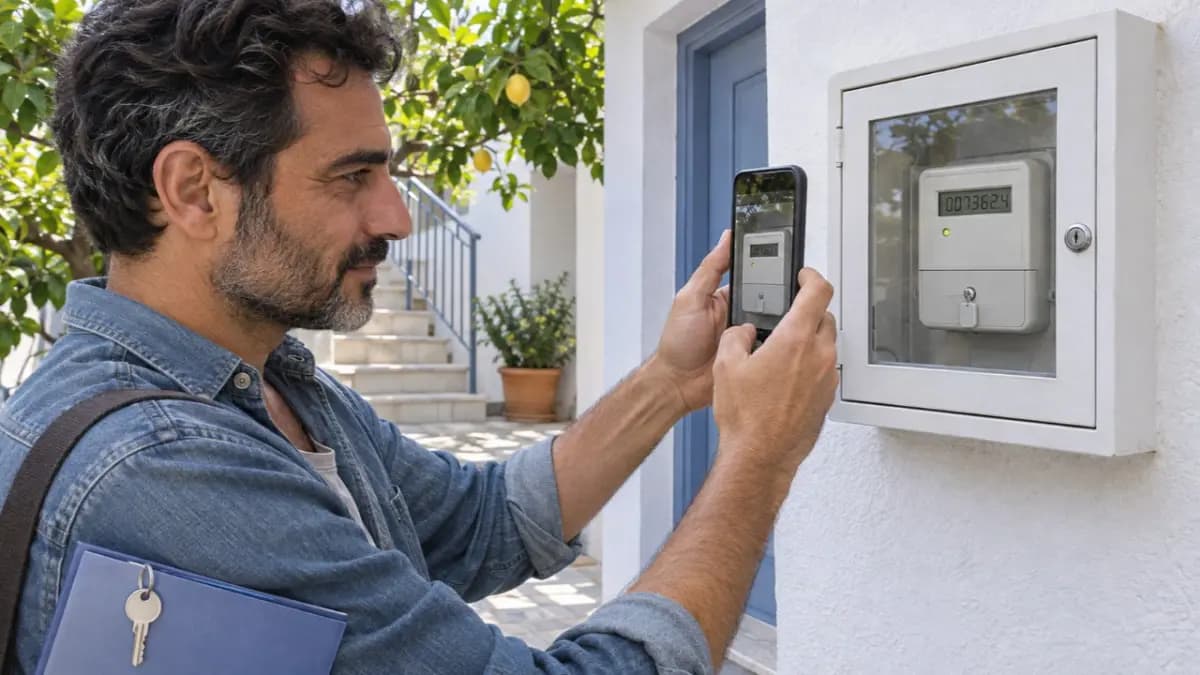
- On handover day, record the date, meter numbers and readings. Take dated photographs and include the details in the handover record. Both parties should keep a copy.
- Arrange the electricity account. Contact the property's supplier before handover to request the current procedure for changing customers, the document list, deposit and fees. Prepare identification, documentation of your right to own or occupy the property, the meter number and a copy of the latest bill. Agree the closing settlement with the outgoing customer. The supplier confirms the final document requirements and terms.
- Apply separately for water. In the EOA Lemesos area, prepare evidence of your right to the property, account details and a photograph of the meter. Procedures and documents depend on the applicant's status. Any outstanding balance on the account must be settled before transfer. See the account transfer form and applicant guidance. For another address, contact its supplier.
- Arrange internet service. Check coverage, the option to transfer or open a connection, and return of the previous customer's equipment.
- Check the first bills. For water and electricity, compare the contract start date, meter number and opening readings. For internet, check the activation date, package, connection charge and equipment charges. Keep confirmation of the outgoing customer's final settlement.
For a water account transfer in the EOA Lemesos area, the supplier lists a €50 deposit for an owner and €250 for a tenant. These are amounts per applicant under the published terms. Reconnecting a disconnected meter follows a separate procedure and carries a €35 charge. Supplier terms.
Budget for deposits and setup fees separately from annual running costs. A refundable deposit is cash that may be required when arranging the service; ask the supplier about repayment terms and any offset against outstanding debts. Responsibility for earlier debts depends on the circumstances and documents. Agree how these will be allocated at handover.
Reserves for maintenance and major work
Treat planned servicing of air conditioners, pumps and other equipment as an expected expense. A reserve is money set aside for future replacement or major repairs. Review equipment age, estimates and decisions made by the development. Where a special contribution has already been approved, use that amount when planning the funds needed. Take any money the development is already collecting for the same work into account when setting your personal reserve.