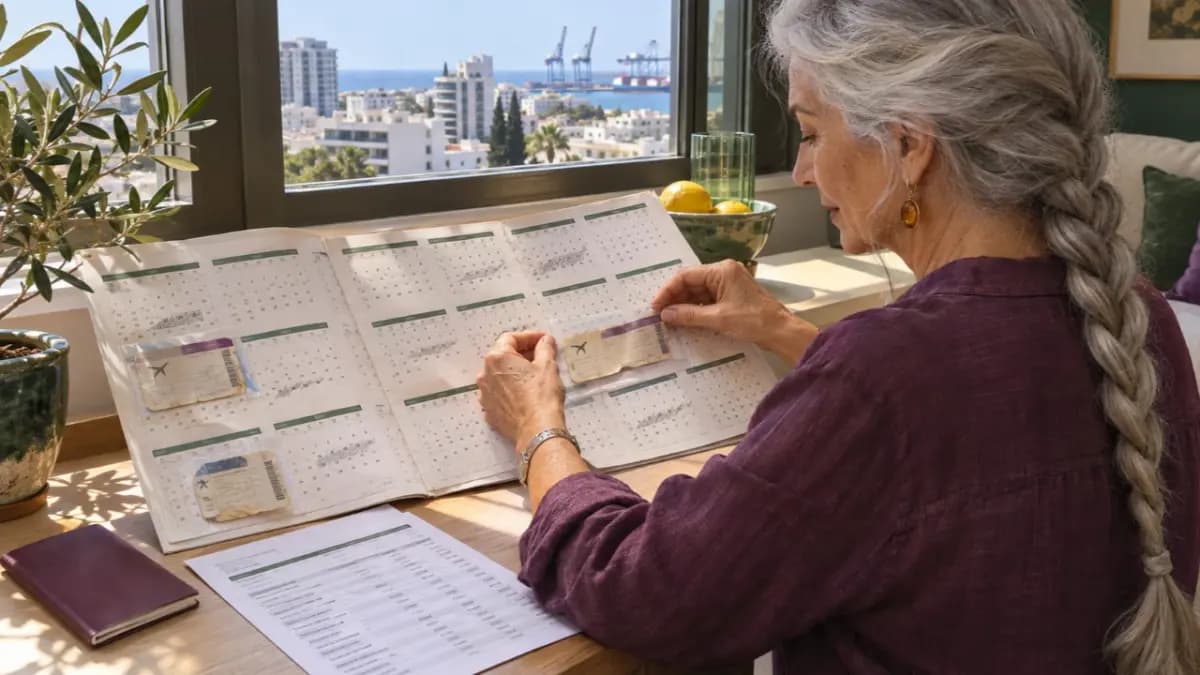
You can be a Cyprus tax resident and qualify for non-dom status at the same time. Tax residency determines your position within the Cyprus tax system for a particular year. Non-dom means that you are not treated as domiciled in Cyprus for Special Defence Contribution (SDC) purposes. If a resident qualifies as non-dom, the exemption covers SDC on dividends and interest. Other taxes and contributions depend on the type of income.
The checks therefore follow a clear sequence: tax year and residency → domicile for SDC purposes → type of income → supporting documents. The distinction between the two tax tests is set out in section 2 of the SDC Law.
This article is for individuals relocating to Cyprus, receiving investment income or returning after time abroad. It covers the Republic of Cyprus, specifically the areas under the effective control of its government, and the 2026 tax year.
Four separate questions
To keep the different statuses distinct, consider what each one establishes and the evidence it requires:
- Physical presence. Where were you, and on which dates? You need arrival and departure dates supported by a travel calendar and records. The result is a record of your presence; residence rights and tax status each require their own legal basis.
- Immigration status. What gives you the right to stay in Cyprus and carry out your planned activities? You need evidence of your basis for residence and the relevant permit or registration documents. These establish lawful residence; tax residency for the year is assessed under separate tax criteria.
- Tax residency. Do you meet the Cyprus tax residency criteria? You need an annual travel calendar and, for the 60-day rule, details of your home and activities. This establishes residency for the year; domicile and your position in another country must then be assessed.
- Domicile for SDC purposes. Does the law treat you as domiciled in Cyprus for this contribution? You need evidence of your domicile of origin and tax residency history. This establishes your position for SDC; other liabilities are assessed by income type.
Domicile is a legal connection between a person and a country, determined by origin and life circumstances. The law distinguishes between domicile of origin, acquired at birth under the applicable rules, and domicile of choice, which involves settling in a country with the intention of living there permanently or indefinitely. The legal basis is sections 6–11 of the Wills and Succession Law, Cap. 195.
Non-dom does not mean non-resident for tax purposes. In this context, it refers to a Cyprus tax resident who qualifies for an exemption under the domicile rules.
Establish tax residency for the year first
For individuals, the Cyprus tax year follows the calendar year: 1 January to 31 December. Days for the residency tests are counted within that year, rather than over any twelve-month period starting on the date of relocation. The first route is to spend more than 183 days in Cyprus. Exactly 183 days does not meet this test. The additional conditions of the 60-day route do not apply to it. The legal basis is section 2 of the Income Tax Law 118(I)/2002.
The second route is the 60-day rule. In the same year, you must meet all of the following conditions:
- spend at least 60 days in Cyprus;
- not spend more than 183 days in any other single country;
- carry on a business or work in Cyprus, or hold an office with a Cyprus tax resident;
- maintain a permanent home in Cyprus, either owned or rented.
Under the wording of the law, terminating the relevant business activity, employment or office during the year prevents that condition of the 60-day test from being met. If you change employers or rely on a combination of qualifying activities, review the sequence of events with a specialist. The conditions appear in section 2 of the current law.
From 1 January 2026, the separate requirement not to be a tax resident of another country no longer applies. The reform removed it; the limit on days spent in any other single country remains. For 2025, consult the previous version of the law. The amendment and its effective date are set out in sections 2 and 25 of Law 244(I)/2025.
Another country may still regard you as its tax resident under its own rules. Once the Cyprus test has been considered, any conflict between the two countries needs a separate assessment.
Then check whether you qualify as non-dom
After establishing residency, assess domicile for SDC purposes separately. If your domicile of origin is outside Cyprus, you need to establish your Cyprus tax residency history and check whether you have previously become deemed domiciled under the special rule. To establish this, review your domicile of origin and Cyprus tax residency history alongside your passport and place of birth.
A person is deemed domiciled for SDC purposes if they have been a Cyprus tax resident for at least 17 of the 20 years preceding the tax year under review. For 2026, the relevant period is 2006–2025; 2026 itself is not included. The legal basis is section 2(3) of the SDC Law.
Start by establishing whether you have been a Cyprus tax resident in any previous year. If you have lived on the island before or have a Cyprus domicile of origin, additional circumstances need to be checked, as discussed later in this article. Assess any exemption period against your domicile and full Cyprus tax residency history, including the years before your most recent move.
What this means for your income
Tax residency determines which income falls within the scope of Cyprus taxation, including income from Cyprus and overseas sources, subject to exemptions. Non-dom answers a narrower question: whether the SDC exemption applies. The legal bases are section 5 of the Income Tax Law and the SDC Law.
- Dividends and relevant interest income: the SDC exemption applies if the recipient qualifies as non-dom. General Healthcare System (GeSY/GHS) contributions and foreign withholding taxes must be checked separately.
- Salary and income from business activities: income tax is assessed under the rules for the relevant income type.
- Rental income: SDC on rent has been abolished generally from 2026. The abolition applies regardless of non-dom status; other taxes and contributions on rental income still require a separate assessment. The legal basis is Amending Law 245(I)/2025, sections 3–4 and 10.
- The sale of property or another asset: the tax consequences depend on the rules for the asset and country concerned.
For dividends from a foreign company, for example, you will need documents showing the gross amount and any tax withheld. The company's own taxes are assessed under the rules applicable to it. The SDC exemption also does not depend on whether the individual transfers the relevant dividends and interest to Cyprus.
Which documents will you need?
Your records should establish the facts for the year under review, your previous history and the details of each income stream. Each group of documents serves a different purpose.
- Dates of presence. Compile a calendar, tickets, boarding passes and available border-crossing records. A specialist checks the calculation to establish the number of days that count for the year.
- The housing condition under the 60-day test. Provide a tenancy agreement or ownership documents, together with details of the period of use. Review the basis for using the home with your adviser.
- Business activity, employment or office held. You, your employer or the company provide contracts, appointment confirmations and details of any termination. Your adviser assesses the timeline relevant to the tax test.
- Domicile and previous years. Gather evidence of domicile of origin, previous residency and, where relevant, extended periods of non-residency. A specialist determines whether non-dom applies or identifies gaps in the evidence.
- Specific income. Obtain payment documents, resolutions and withholding statements from the payer, and add bank statements. Together, these establish the type, source, date and amount of the income.
The final set of documents required for an application to the Cyprus Tax Department depends on the procedure and the applicant's circumstances.
Counting days: apply the Cyprus rules to arrivals and departures
- Arrival in Cyprus counts as a day in Cyprus.
- Departure from Cyprus counts as a day outside Cyprus.
- Arrival and departure on the same day count as a day in Cyprus.
- Departure and return on the same day count as a day outside Cyprus.
These are the day-counting rules in section 2 of Law 118(I)/2002.
For example, if you arrive on 10 June and leave on 20 June, the days from 10 to 19 June count as days in Cyprus: ten days in total. Apply the other country's own rules when preparing its travel calendar.
What a housing agreement establishes
A tenancy agreement or ownership document establishes your basis for using the home. Travel dates are supported by border-crossing records; business activity or employment by work or appointment documents; and domicile by evidence of your domicile of origin and tax residency history. Assessing tax on a payment requires documents for the income itself.
Renting is permitted under the 60-day route: this condition does not require you to buy a home. If the housing evidence is in place but it is unclear whether employment continued or when it ended, you still need the employment records.
A tax residency certificate and evidence of non-dom status
First establish who is requesting the document and what they need it to confirm: Cyprus tax residency for a particular year, or an SDC exemption under the domicile rules. These are different matters.
The Cyprus Tax Department's page on tax residency and domicile separately lists declaration T.D.38 for exemption from SDC where a person is not domiciled in Cyprus, and questionnaires T.D.038QA/038QB on domicile of origin and domicile of choice. A tax residency certificate is covered by a separate procedure. Before applying, check the current forms and documents required for your circumstances.
If a foreign authority needs the certificate, obtain its requirements for the relevant year, content and format in advance. Your position in another country is assessed under its rules and the applicable international treaty.
How to assess a case involving 75 days in Cyprus
In 2026, an individual rents a home from January, starts working in Cyprus in March and finishes the year with 75 days that count as presence in Cyprus. They spend no more than 183 days in any other single country. In December, they receive dividends.
- January: housing. There is an agreement, but the period of actual use has not been clarified. The next step is to check the dates and terms of the agreement.
- March onwards: employment. The start date is known, but it is unclear whether employment continued or when it ended. Establish the employment dates and the termination date, if applicable.
- Non-dom assessment: previous history. The current move is being considered, but there is no record of domicile or previous Cyprus tax years. Prepare a timeline covering earlier years.
- December: dividends. The payment has been received, but not all applicable liabilities or the other country's requirements have been established. Gather the payment documents and check both jurisdictions.
Once the documents are available, there are two possible outcomes:
- All conditions of the 60-day test are confirmed. A conclusion can be reached on Cyprus tax residency for 2026. Non-dom eligibility is then assessed separately using domicile of origin and previous history, followed by the consequences for the dividends.
- A mandatory condition is not met. The 60-day route requires all its conditions to be met, including those beyond the 75 days of presence and the tenancy agreement. The alternative route requires more than 183 days, so the final total of 75 days falls short. Non-dom eligibility can be assessed only after a basis for Cyprus tax residency has been established.
If you have lived in Cyprus before or are returning after a long absence
Previous years of tax residency matter when you return. Suppose someone was a Cyprus tax resident continuously from 2009 to 2025. That is 17 years within the 2006–2025 window. Eligibility for any exemption in 2026 must therefore be assessed against those 17 years of residency, including when the person changes address or submits a fresh application.
For someone with a Cyprus domicile of origin, the law provides specific exceptions linked to extended periods of non-residency and, where applicable, a domicile of choice abroad. A specialist should assess these against the person's precise timeline. This assessment requires the exact years of residence abroad and supporting evidence.
A short absence does not reset deemed domicile previously acquired under the 17/20 rule either. Whether that domicile continues and whether the person is a tax resident in the new year are separate checks. The legal basis is section 2(3) of the SDC Law.
For certain individuals who have become deemed domiciled, a separate SDC arrangement involving payment is available. Access requires meeting its own conditions and completing an approval procedure. The legal basis is section 3D of the SDC Law.
What to review when circumstances change
Each change calls for a review of particular conditions.
- More travel: recalculate the days that count in Cyprus and the days spent in each other country.
- Employment, business activity or an office ends: check the termination provision of the 60-day test for the year concerned.
- Use of the home ends: reassess the housing condition if you rely on the 60-day route.
- Departure followed by a return: check residency for the new year and all relevant previous history.
- Another country makes a tax claim: examine its domestic rules and the relevant provisions of the applicable international treaty.
- The type of income changes: establish how the new income is classified for tax purposes and prepare supporting documents.
In a dual-residency case, first establish the person's position under each country's domestic law, then check whether an international treaty exists and applies. The other country's requirements must be assessed under its legislation and the applicable treaty.
For the final review, prepare a single set of records:
- A travel calendar for the relevant year, with evidence of arrivals and departures.
- Housing and activity documents, including the dates when employment, business activity or an office began, changed or ended.
- A history of previous tax years marked “resident”, “non-resident” or “to be established”, together with domicile records. Where a year's status is unknown, mark it “to be established” and gather supporting evidence.
- An income schedule showing the type, payer, country, date, amount and withholding for each payment.
- The requirements of whoever will receive the certificate or other confirmation.
Using these records, a specialist should establish residency for the relevant year, non-dom eligibility, the consequences for each income stream and the appropriate supporting document separately. If a conclusion is not yet possible, ask them to identify the missing fact or document.